This is a space for me to document my explorations in and reflections on my interests in art, science, music, knowledge, science communication, engagement between scientists and society, and other ideas. See About for more details. Use the menu at the top to explore, or click on the links below.
I found a recent paper by Jude Fransman, about different perceptions of Public Engagement, enlightening and inspiring, and it led me to write a blog piece about it (link). I also interviewed Jude, and publish the transcript below, as it goes into much more detail than the blog, and also gives her perspective.
Funding for British sport at the Olympics is pretty cut-throat. If your sport is unlikely to get a medal, you are likely to get nothing from UK Sport. So 1st to 3rd means money, 4th or below means none. This has been a spectacularly successful policy in terms of medal results, though controversial in wider terms of how it relates to levels of participation in sports, how the individual sports can develop sustainably, and how broad the funding should be in this all-or-none system.
Funding research
The situation is a little similar for how research is funded at UK universities…
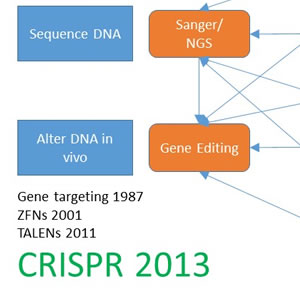
Gene Editing is a technology that is increasingly impacting on society and our lives. What was hard to do became simple, and with that a host of new possibilities - and ethical issues - were unleashed.
In this dissertation I discuss the context of Gene Editing as a tool, and how it sits with other technologies. I argue that it's not a complete stand-alone technology, but rather that it completes 'the toolbox' that geneticists have been developing since the first cloning experiments in the 1970s.
A farmer can remember what has happened last year and the year before, and can prepare accordingly. But what about plants? How can they pass on their experience to their offspring?
It turns out that they can and do, and by being prepared, the new plants will grow better than they otherwise would have.
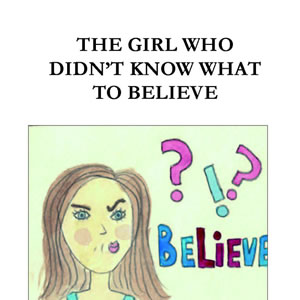
A story for children, about a young girl who accepted everything as true. Triggered by a family crisis, she starts to explore questions about truth, knowledge, evidence and belief. Written by Àngels Codina, Flora McCrone and Neil Stoker. Illustrations by Flora McCrone.
Gene editing is possible through harnessing the defence mechanisms of bacteria. Similar genes have now been found in unusual giant viruses.
First things first, in case you read no further: go and see Alice Anderson’s exhibition, Memory Movement Memory Objects, at Wellcome Collection. I found parts of it extraordinary, that I have returned to repeatedly. The curation, integrating strong design and careful lighting with the artist’s works, has produced effects that are aesthetically powerful and thought-provoking.
But I’ve struggled to write this piece, to express what it meant for me in the context of what it appeared to mean for the artist, and why it was in this venue.
I'm interested in Citizen Science - where people take part in science research through non-traditional routes. Here I talk to someone, untrained in science, who’d worked on astronomy projects in the online Zooniverse platform in her spare time. Was she a technician, or had it become more than that?
As a biologist, I’m used to the idea that elements combine to form simple and complex molecules in an orderly way, and with a ‘purpose’. How different it must appear to the geologist, who studies the rocks that make up our planet. While the basic tools that form these objects – matter and energy – are the same, the scale is massive, the forces and timescale barely imaginable, and here there is no guiding template, no enzymes to channel the way molecules combine, just a relentless chain of events.
Art and other visuals